

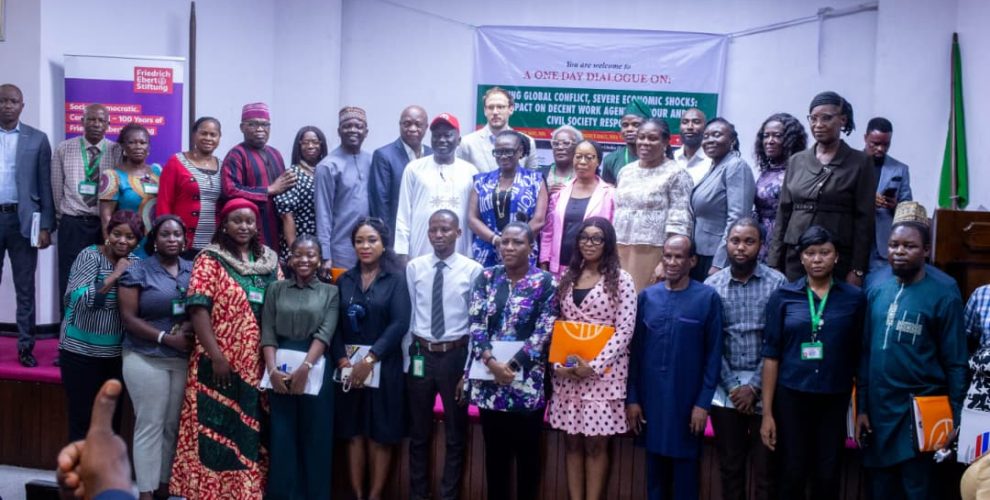
Director-General and Chief Executive Officer of the Michael Imoudu National Institute for Labour Studies (MINILS), Ilorin, Comrade Issa Aremu, has warned that rising global conflicts and economic crises are posing serious threats to workers, jobs and economic stability across the world.
Speaking at a one-day collaborative dialogue on “Rising Global Conflicts, Severe Economic Shocks: Impact on Decent Work Agenda; Labour and Civil Society Response,” Aremu said the growing wave of conflicts across different regions had continued to worsen the conditions of workers and undermine the decent work agenda.
The dialogue was jointly organised by the Nigerian Institute of International Affairs (NIIA), Michael Imoudu National Institute for Labour Studies (MINILS) and Friedrich Ebert Stiftung (FES).
Aremu noted that violence across Africa had displaced over 35 million people, representing nearly half of the global population displaced by conflicts. He added that the escalating crisis in the Middle East, particularly after the February 28, 2026 developments, had triggered severe economic shocks with far-reaching consequences for workers and businesses.
According to him, violent conflicts, insurgency and banditry have led to the deaths of many workers, while workplaces and businesses in affected areas have been destroyed, resulting in rising unemployment and declining incomes.
“In areas directly impacted by conflict, workplaces are destroyed, businesses shut down, unemployment rises and workers’ incomes come under severe strain,” Aremu stated.
He further expressed concern over the growing wave of irregular and forced migration caused by conflicts, noting that the situation had contributed to xenophobic attacks in countries such as South Africa.
The MINILS DG stressed that Nigeria’s economy remains vulnerable because of its dependence on global oil markets and international trade. He explained that rising fuel prices, food insecurity, currency instability and declining purchasing power were already placing enormous pressure on workers and businesses.
“For countries like Nigeria, whose economic stability is closely tied to global oil markets and international trade, these developments pose serious challenges,” he said.
Aremu also lamented the negative impact of global crises on decent work, job security and workers’ wages, urging organised labour to become more proactive in responding to emerging economic and social challenges.
“Africa must sit up. We must bring development to the agenda. Peace is eluding the world,” he added.
Other stakeholders at the event, including labour leaders, academics, government officials and civil society organisations, also stressed the need for collective efforts to address the growing economic and social pressures facing workers.


Leave a Reply